
Your cart is empty.
You need to buy things!
You need to buy things!

"If Picasso invented Cubism and Braque constructed it, Juan Gris made it a science." This phrase alone summarizes the capital, and often underestimated, importance of this Spanish genius. Juan Gris (1887-1927) was not a follower. He was the one who took the creative chaos of his predecessors and turned it into a clear, luminous, and intelligible visual language.
While Picasso destroyed forms with Dionysian rage, Gris reconstructed them with the precision of an architect. A major figure of Synthetic Cubism, he left an indelible mark on modern art before tragically passing away too soon. Let’s dive together into the life, technique, and legacy of the man who wanted to "organize sensation." 📐
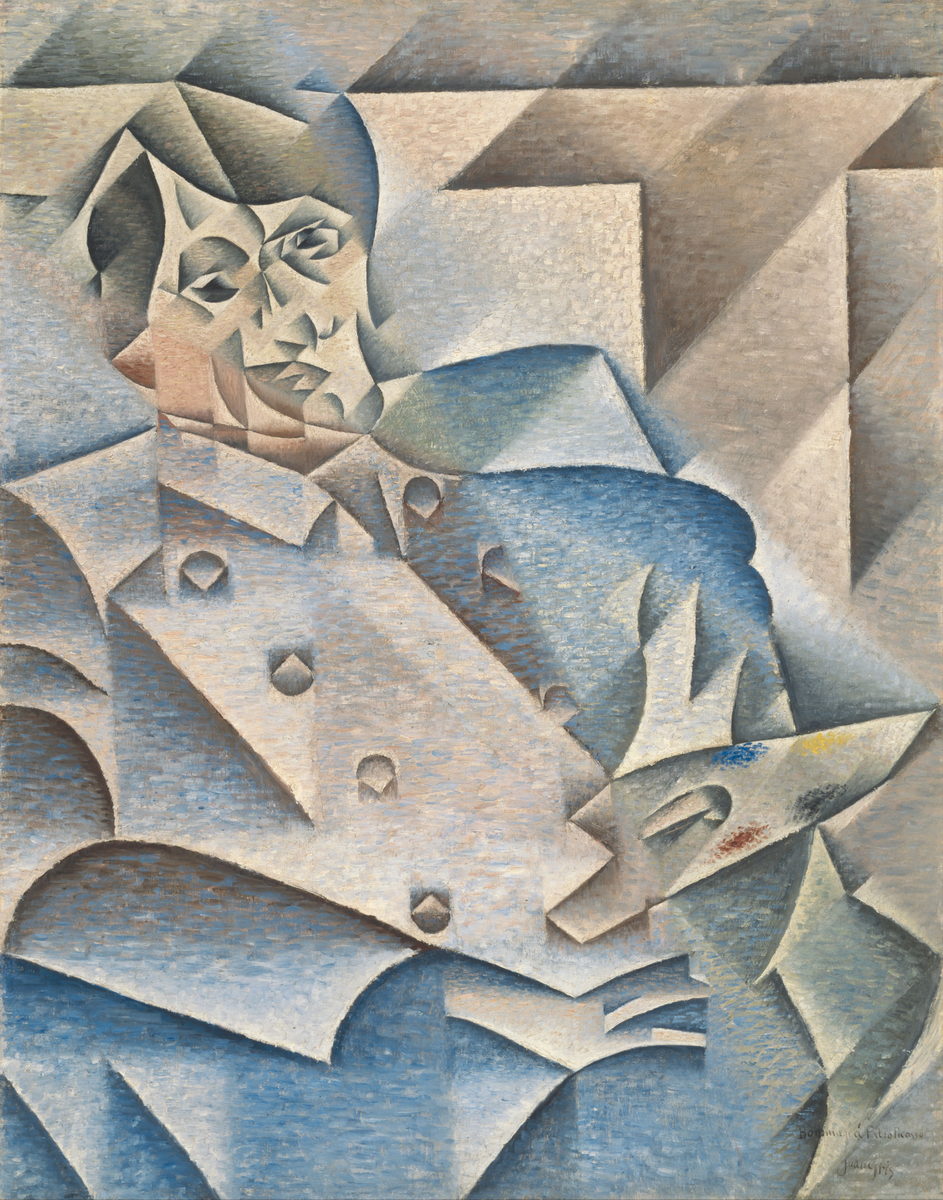 Tribute to the master: "Portrait of Pablo Picasso" (1912), one of his first major Cubist works.
José Victoriano González Pérez was born in Madrid on March 23, 1887. He was the thirteenth of fourteen children in a bourgeois family. Very early on, he turned his back on a classical academic career to enter the School of Arts and Crafts in Madrid. It was there that his gaze was forged: mathematical, precise, technical.
Before being a painter, young José was an illustrator. Under the pseudonym Juan Gris, he published caricatures in satirical magazines like Madrid Cómico. This background as a press cartoonist was crucial: it taught him to simplify the line, to get to the essential, to synthesize an idea in a few strokes. He was also influenced by Jugendstil (German Art Nouveau) and by Spanish masters like Zurbarán for the rigor of his still lifes.
In 1906, at 19, he fled military service and the narrowness of Madrid for Paris 🗼. He landed at the Bateau-Lavoir, that dingy phalanstery in Montmartre without water or electricity, a true laboratory of modern art. His studio neighbor? Pablo Picasso.
Gris observed. He watched Picasso and Braque develop Analytical Cubism, breaking objects into monochrome facets. But Gris did not copy immediately. He digested. He frequented Apollinaire, Max Jacob, Pierre Reverdy. He waited until 1911 to present his first Cubist canvases. And there, it was a shock. Unlike the sometimes illegible canvases of his friends, Gris’s were bathed in light, ordered, almost crystalline. He brought a Latin clarity to Cubism.
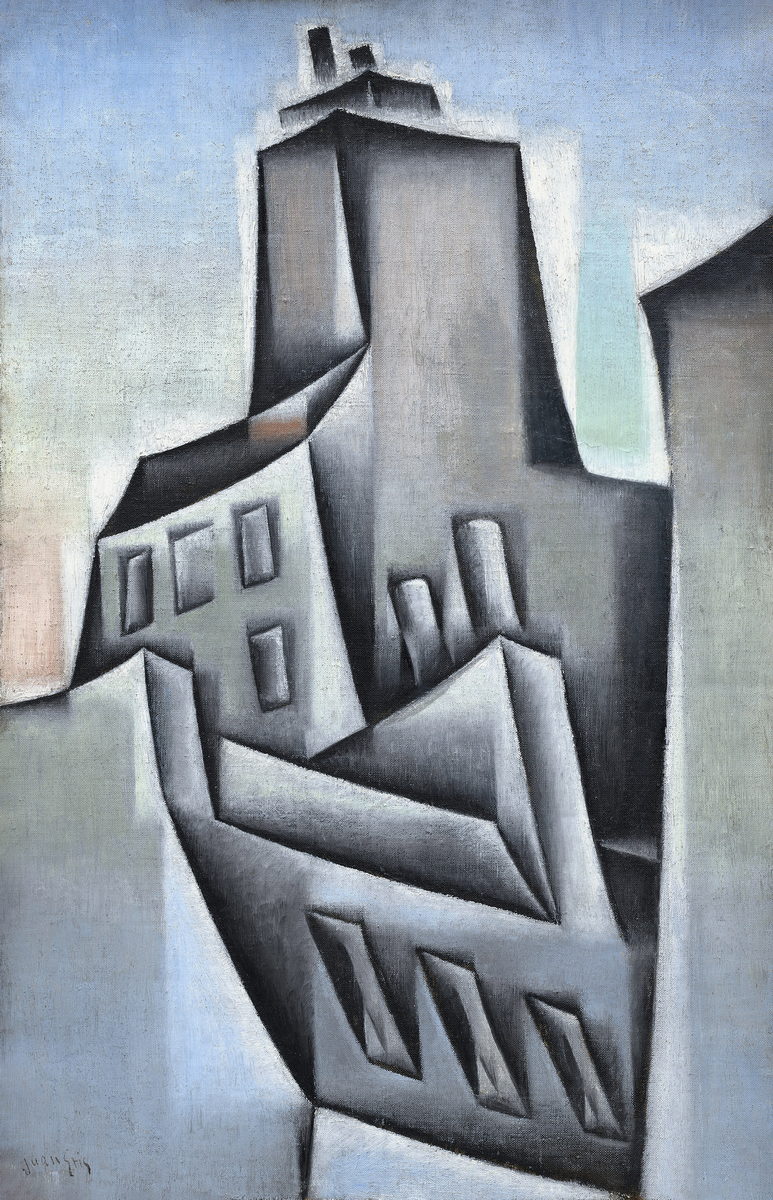 Houses in Paris (1911): The geometric structure begins to impose itself.
Juan Gris’s art is divided into two main phases that mark the evolution of the entire movement.
Initially, Gris adopted the fragmentation of objects and the multiplication of viewpoints. But where Braque and Picasso used dull colors (gray, ochre, brown), Gris dared to use color. He maintained a visible, structuring geometric grid. He used the "golden ratio" to compose his canvases. It was cerebral painting.
This is his major contribution. From 1913 onwards, Gris reversed the process. Instead of starting from an object (a bottle) to deconstruct it into abstract forms, he started from abstract forms (a cylinder, a rectangle) to make an object. He said: "Cézanne made a cylinder out of a bottle, I make a bottle out of a cylinder."
He introduced papiers collés (pasted papers): pieces of newspaper, wallpaper, faux wood. These elements of reality anchored the composition. The artwork became an autonomous object, a "flat and colored architecture."
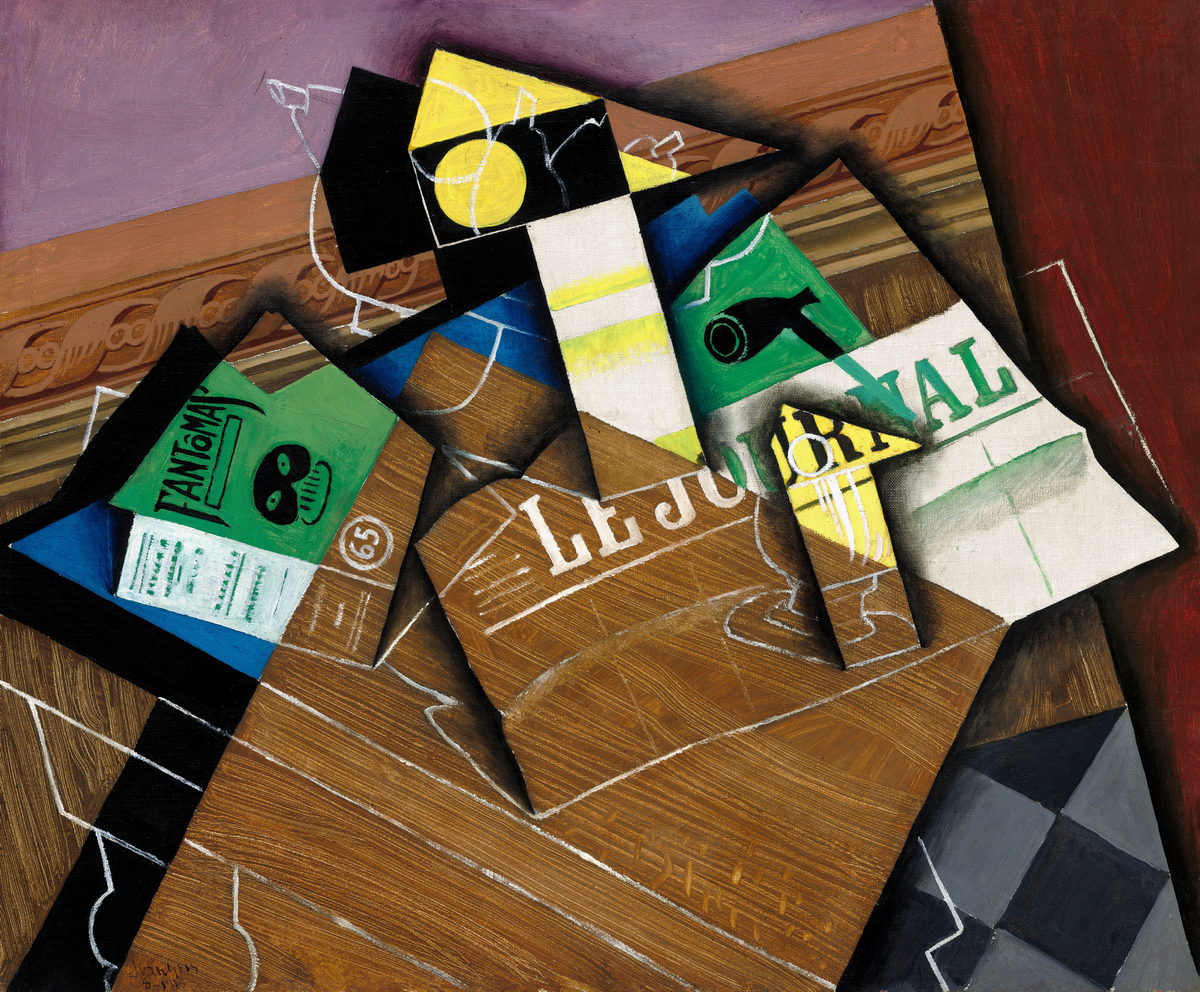 Fantômas (1915): A masterpiece of Synthetic Cubism mixing abstraction and pop culture.
Juan Gris’s universe is an interior world, intimate and silent. We find fetish objects that return like leitmotifs:
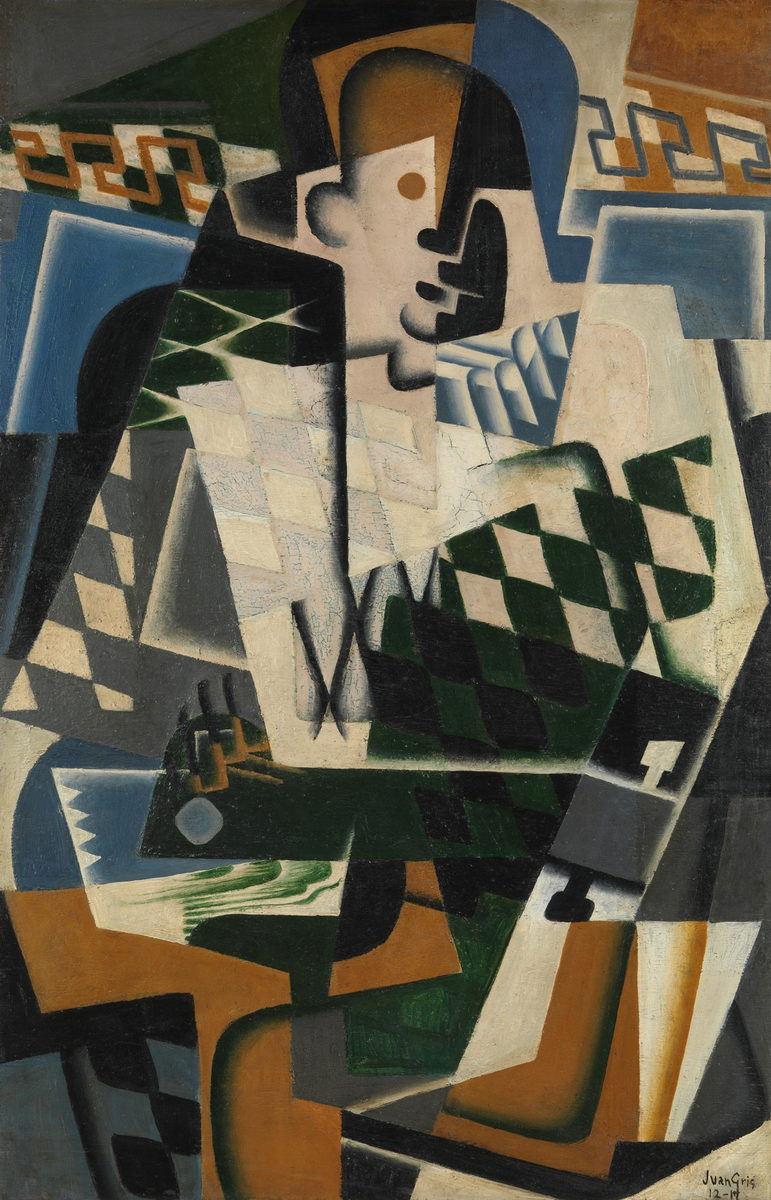 Harlequin with a Guitar (1917)
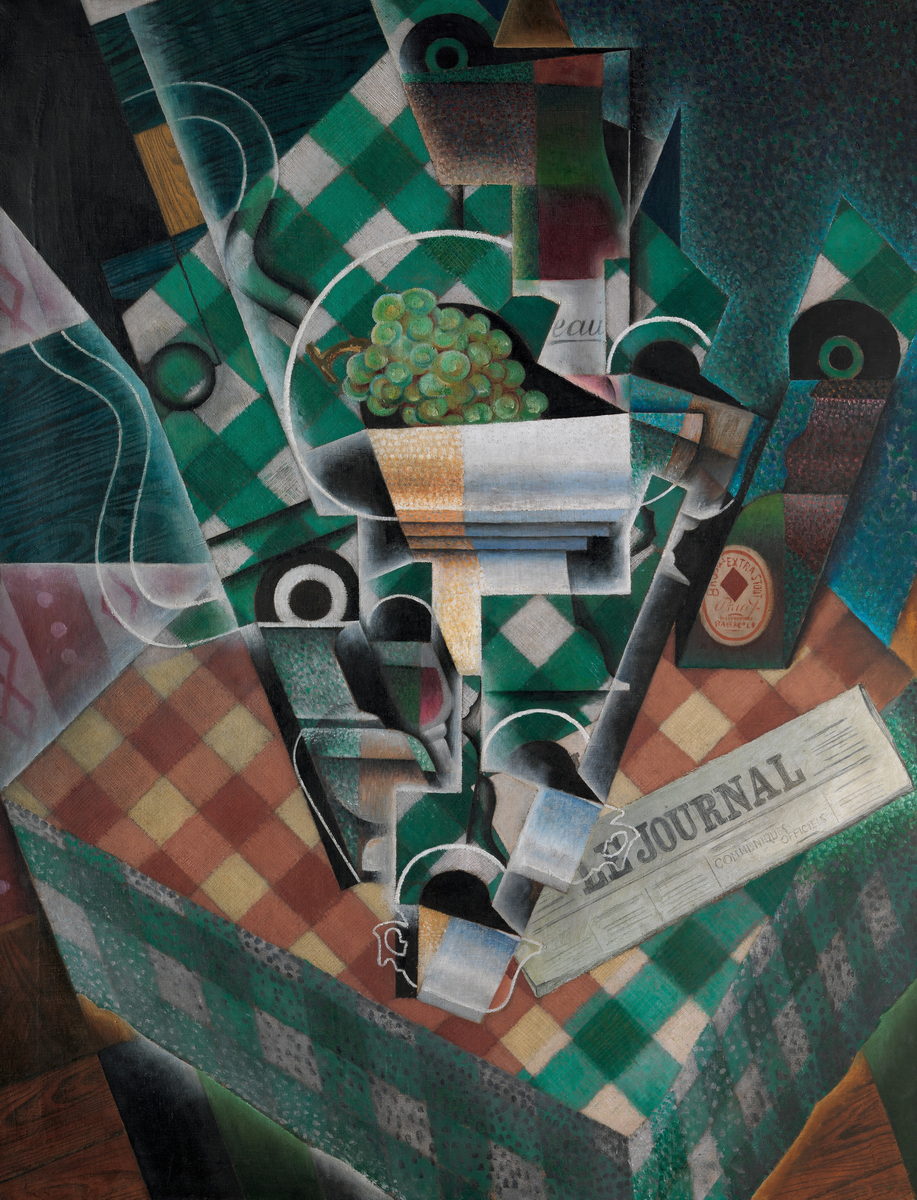 Still Life with Checked Tablecloth (1915)
Gris was not instinctive like Picasso. He was an intellectual. He corresponded with poets, debated the fourth dimension, the golden section. For him, painting was not an imitation of the world, but a mathematical creation. He sought constants, universal laws of harmony. His famous sentence "I make with my head what others make with their heart" illustrates this will for absolute mastery. He wanted the painting to be as precise as an equation, but as moving as a poem.
Gris’s destiny is tragic. As early as 1914, the war trapped him in Paris. His contract with the German dealer Kahnweiler was broken, leaving him without resources. He lived in poverty, supported by Gertrude Stein and later by Léonce Rosenberg. But the real enemy was internal. Like many artists of his time, he suffered from uremia, asthma, and poorly treated pleurisy.
The 1920s were a race against time. Despite stays in the south of France to treat his lungs, his health declined. He died in Boulogne-sur-Seine on May 11, 1927, at only 40 years old, leaving behind a dazzling but unfinished body of work. 💔
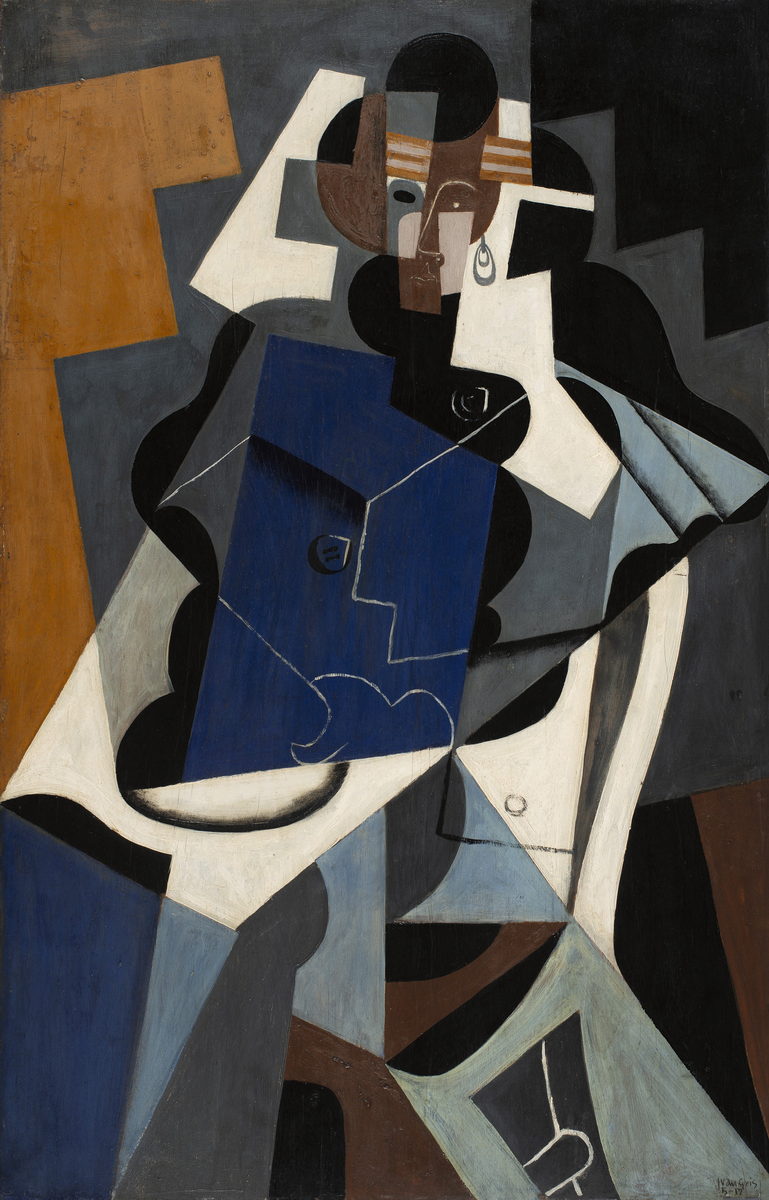 Portrait of his wife Josette, unwavering support during his illness.
Long overshadowed by the two giants Picasso and Braque, Juan Gris was rediscovered in the 1950s. He is now considered the "classical" pillar of Cubism. His influence was immense on the Purism movement (Le Corbusier, Ozenfant) and on geometric abstraction. Today, his canvases fetch gold prices at auctions (his painting "Still Life with Checked Tablecloth" sold for over 56 million dollars in 2014! 💰).
To fully understand Juan Gris’s singularity, nothing beats a direct comparison with his cohorts from the Bateau-Lavoir:
| Aspect | Pablo Picasso | Georges Braque | Juan Gris |
|---|---|---|---|
| Spirit | Intuitive, destructive, emotional | Experimental, artisanal, tactile | Rational, constructive, scientific |
| Color | Often dull, earthy (Analytical period) | Gray, beige, neutral | Vivid, luminous, contrasted, bold |
| Intention | Total creative freedom | Spatial and material research | Pure geometric harmony and clarity |
| Process | From object to abstraction | From object to abstraction | From abstraction to object (Synthesis) |
Juan Gris proved that rigor is not the enemy of poetry. On the contrary, by structuring chaos, he offered the world a peaceful and luminous vision of modernity. He is the painter of perfect balance. Owning a reproduction of Juan Gris means bringing that visual intelligence, that timeless elegance that continues to fascinate a century later, into your home. Rediscover this discreet master who knew how to make geometry sing. ✨
Save 15 % on orders over $400 excl. tax and 20 % on orders over $800 excl. tax |


